Introduction
Tesla’s highly anticipated launch of the new Canadian-market Model 3 Premium RWD is turning from a celebration into a serious public relations headache. What began as an impressive budget EV launch is now raising serious questions about transparency, corporate credibility, and specification accuracy.
At launch, Canadian buyers thought they were getting a remarkable deal — a premium Tesla with sports-car-level acceleration at the lowest price ever offered in the country. However, a series of quiet, rapid-fire downgrades on Tesla’s online configurator have left both industry watchers and early buyers deeply concerned.
The Aggressive Launch and the “Website Mistakes”
On May 1, Tesla officially launched the Shanghai-built Model 3 Premium RWD in Canada, priced at just $39,490 CAD — making headlines across the automotive world.
Along with the competitive price, Tesla advertised specs that seemed almost too good to be true for a base model:

0–100 km/h in just 4.2 seconds
463 km of driving range
250 kW DC fast charging
The excitement was short-lived. Within days, Tesla quietly altered the vehicle’s configurator, downgrading several key specs. Acceleration slipped to 5.2 seconds, charging speeds were cut to 175 kW, and the battery warranty dropped from 192,000 km to 160,000 km. Tesla reportedly described these changes as a “website mistake.”
Tesla Canada did not respond to a request for comment regarding the specification changes at the time of publication.
The Second Downgrade: Two Seconds Slower Than Promised.
Less than three weeks after launch, Tesla updated the configurator again — pushing the 0–100 km/h figure back further to 6.2 seconds. The car is now officially two full seconds slower than what was advertised on launch day.
Spec Revision Timeline
Spec Revision Timeline
| Date | 0–100 km/h | Peak Charging | Battery Warranty |
|---|---|---|---|
| May 1 (Launch) | 4.2 sec | 250 kW | 192,000 km |
| ~May 3 | 5.2 sec | 175 kW | 160,000 km |
| ~May 19 | 6.2 sec | 175 kW | 160,000 km |
The Reality Behind the Numbers: Hardware Changes
The 6.2-second figure is not arbitrary. According to Sawyer Merritt, a widely followed EV industry analyst, this number aligns precisely with Tesla’s European specifications for the identical Shanghai-built variant — strongly suggesting the original 4.2-second claim was never achievable with this hardware configuration.
Alistair Weaver, automotive editor at Edmunds, noted: “A two-second discrepancy in acceleration figures is not a typo. That is a fundamentally different powertrain promise.”
The performance gap comes down to two hardware realities:

The Motor: The Canadian version uses Tesla’s newer 3D7 rear motor, producing 194 kW and 340 Nm of torque. The older Fremont-built Model 3 previously sold in Canada used the stronger 3D6 motor, rated at 220 kW and 440 Nm.
The Battery Chemistry: The new model uses a Lithium Iron Phosphate (LFP) battery pack. While LFP chemistry is praised for being cheaper, safer, and longer-lasting, it delivers lower peak discharge rates than NMC (Nickel Manganese Cobalt) chemistry — directly limiting acceleration performance.
Buyer Reaction: “I Feel Misled”
Early reservation holders have expressed frustration across Canadian EV forums and social media.
Mark D., a Toronto-based buyer who placed a reservation on launch day, told EV Canada Weekly: “I reserved specifically because of the 4.2-second figure. That’s the difference between a performance car and a regular commuter. I feel misled.”
This sentiment is echoed widely in the Tesla Motors Club Canada forum, where threads about the spec changes have accumulated hundreds of responses since early May.
Conclusion: Value Remains, But Trust Is Damaged
Despite the backtracking, the Model 3 Premium RWD remains a genuinely strong value at under $40,000 CAD. A 6.2-second 0–100 time is perfectly respectable for a daily commuter sedan, and the LFP battery offers long-term durability advantages.
However, for many consumers, the issue is no longer about whether 6.2 seconds is fast enough. The core problem is trust. Launching a major vehicle with figures that are subsequently revised twice — by a combined two full seconds — damages consumer confidence at a critical moment. Tesla is facing intensifying global competition from Chinese EV makers such as BYD, which recently overtook Tesla in global EV sales for the second consecutive quarter, and cannot afford to give buyers reasons to hesitate.
Transparency, not just pricing, will determine who wins the next generation of EV customers.
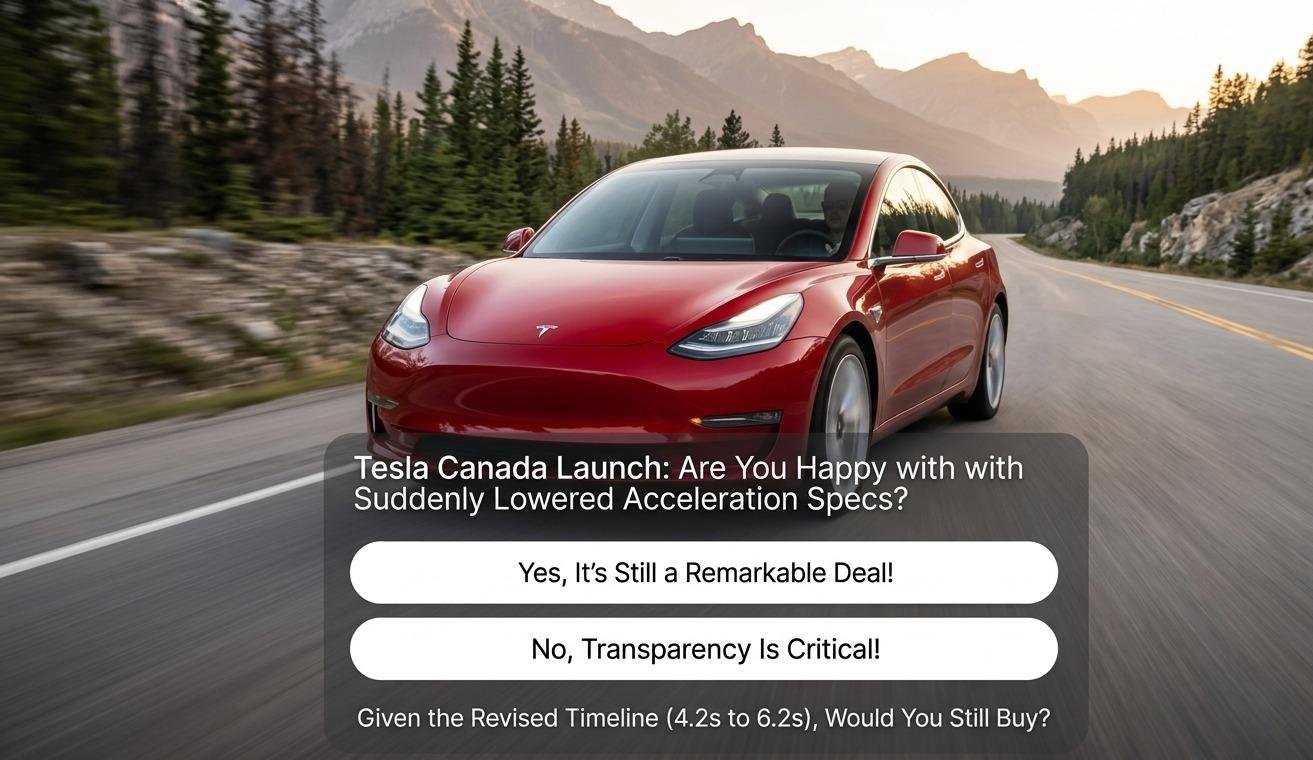
Are you happy with Tesla’s sudden move and will you buy the Tesla Model 3?


Hi, I’m Nadeem Ahmad, the founder and writer behind Pedego.I created this website because I have always been passionate about cars and the technology behind them. Over the years, I noticed many people struggle to find simple and trustworthy information about vehicles — most sites are either too technical or just copy specifications without real explanation.